
💰 (A thought-provoking reality check by Save Handloom Foundation)
You walk into a store—or scroll through an online page—and see a beautiful “handloom” saree priced at ₹2,000.
The color speaks tradition, the label says “sustainable,” and the description proudly mentions handcrafted by artisans.
But here’s the question no one asks:
👉 If you paid ₹2,000, how much actually reached the hands that wove it?
Let’s unravel the truth thread by thread.
🧵 Step 1: The Journey Begins — From Fiber to Fabric
Raw cotton or silk: The weaver doesn’t grow this. They buy it—already spun, often through cooperative societies or private traders.
- Cost share: ~₹200–₹300 per saree.
- Hidden truth: Fluctuating raw material prices hurt small weavers the most. When yarn prices rise, their income falls—but market prices rarely increase to compensate.
Dyes and processing:
Natural dyes are costly; synthetic ones are cheap but harmful. Most weavers are forced to choose affordability over ecology.
- Cost share: ₹100–₹150 per saree.
- Environmental impact: Synthetic dyes release micro-toxins into rivers, killing aquatic life and contaminating soil.
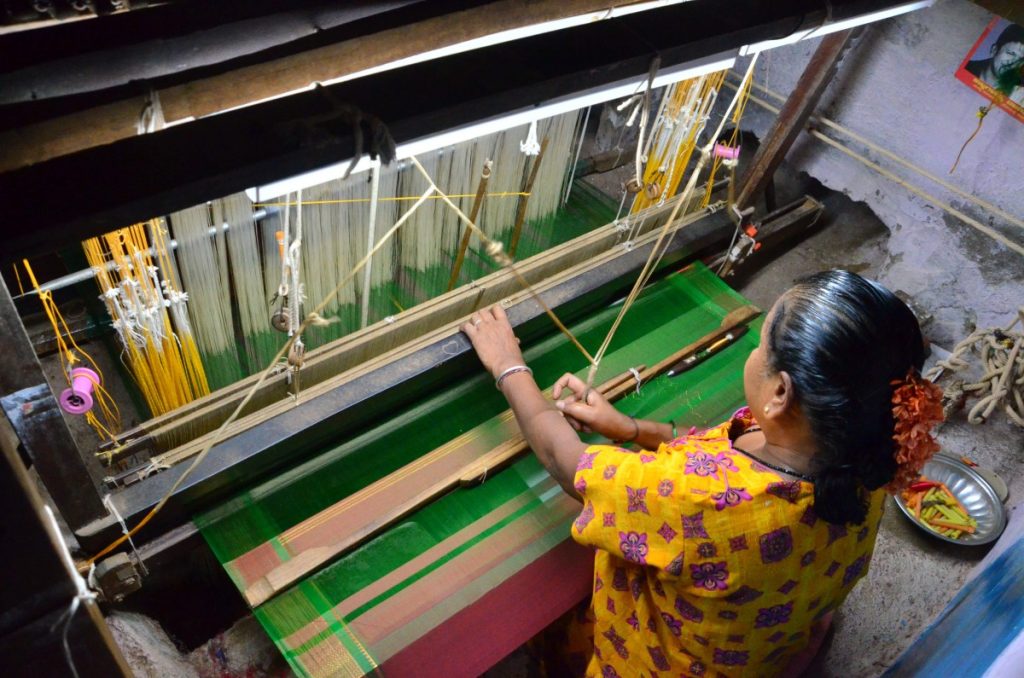
👣 Step 2: The Weaver’s Labor — The Soul of the Saree
A single handloom saree can take 3 to 15 days to weave, depending on complexity. The average daily earning for a weaver?
Barely ₹300–₹500 a day.
So, even for a saree sold at ₹2,000, the weaver’s actual earning may be around:
👉 ₹500–₹600.
That’s less than 30% of what you pay.
And mind you, this isn’t profit—it’s survival money.
Most weavers don’t have social security, health insurance, or pension benefits. Their children see them struggle and move away from weaving, causing a slow extinction of a 2000-year-old skill.
💼 Step 3: Enter the Middlemen — The Value Leak Begins
The moment the saree leaves the loom, the real game starts.
Middlemen—local agents, traders, and master weavers—control the pipeline.
They advance money for yarn, sometimes at high interest, and in return dictate the selling price.
Even government cooperatives, while better in intention, often suffer from bureaucracy and delayed payments.
By the time the saree reaches a brand or a retail store, the cost has ballooned:
| Stage | Approx. Cost Added | Who Gains |
|---|---|---|
| Weaver sells to trader | +₹700 | Trader earns 20–30% |
| Trader sells to brand | +₹400 | Brand gets raw stock cheap |
| Brand adds marketing, packaging | +₹500 | Brand margin 50%+ |
| Consumer buys at | ₹2,000 | Weaver gets only ₹500–₹600 |
This is how a weaver’s week-long labour becomes someone else’s “margin.”
🏷️ Step 4: The “Sustainable” Illusion
The modern buzzword “sustainability” is being sold like a designer tag.
Brands add green-colored packaging, write a poetic product story, and charge a premium—without ensuring that the weaver’s life has improved one bit.
True sustainability isn’t about eco-friendly dyes or organic tags alone.
It’s about equity and traceability—ensuring every rupee you pay can be traced back to a fair wage, clean process, and genuine craft.
If your ₹2,000 saree claims to be “ethical,” ask:
- Did the weaver get paid fairly?
- Was the dyeing process non-toxic?
- Can the brand prove authenticity with a Digital Product Passport (DPP) or traceability record?
If they can’t answer, that “handloom” might just be another powerloom pretending to be art.
🌍 Step 5: Environmental Cost — The Silent Victim
Fast fashion sarees made from polyester and synthetic blends are flooding the market under fake “handloom” tags.
Every wash releases microplastics into water bodies.
Every chemical dye pollutes a river.
Every fake saree displaces a real weaver.
So when you choose cheap, you’re not saving money—you’re funding the slow death of ecosystems and livelihoods.
🔍 The Wake-Up Call
Every saree has a story. But only a few are truly transparent.
Next time you buy one, trace the money trail.
If you pay ₹2,000, ask the seller or brand:
“How much went to the weaver?”
If they hesitate, you already have your answer.
🕊️ The Way Forward
At Save Handloom Foundation, we believe in a transparent chain.
Through blockchain-enabled Digital Product Passports, we ensure each product carries its origin, weaver details, raw material source, and wage breakdown — so you can see where your money really goes.
Because true sustainability is not a slogan.
It’s a system that ensures fairness, traceability, and respect — from fiber to fashion.
✊ Action Prompt
Before you buy your next saree, don’t just admire the weave.
Trace it. Question it. Respect it.
Your curiosity can change a weaver’s life.