
In most industries, B2B buyers start by asking one basic question: Are you the manufacturer, wholesaler, or a reseller?
But in handloom, the answer isn’t that simple — and it shouldn’t be.
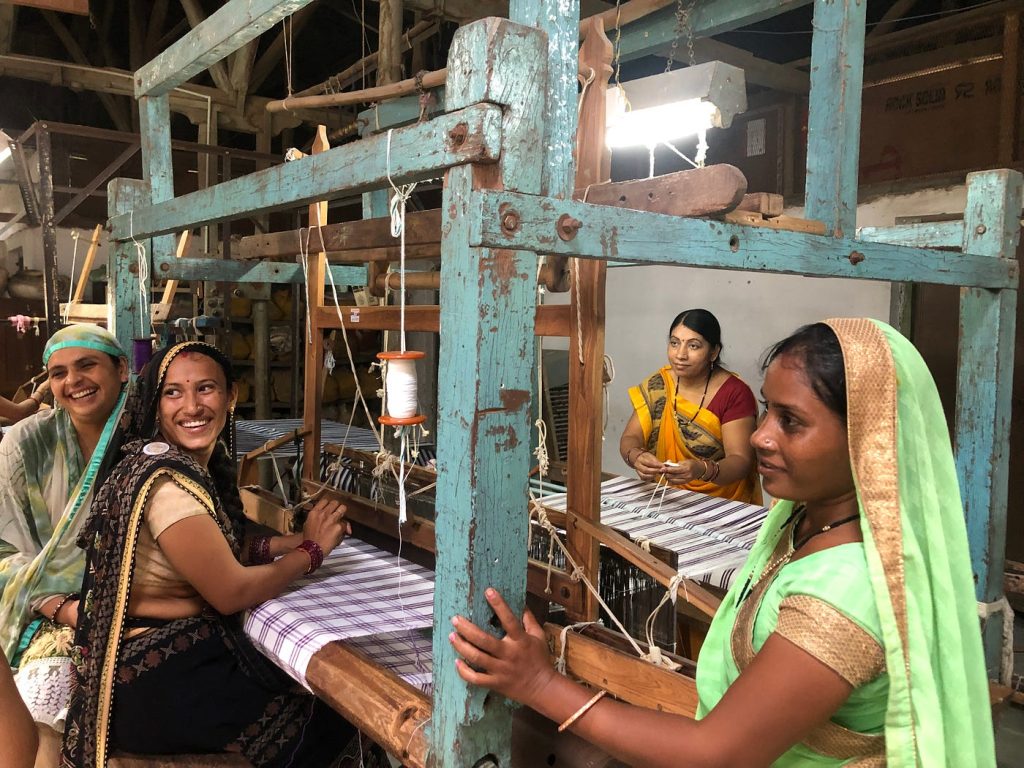
Because here’s the truth: our “manufacturing unit” isn’t a factory with chimneys and machines. It’s the quiet rhythm of a loom in a humble home in a remote village of India. That home, that loom, and that family — they are the heart of our business. Every single project begins there.
The Illusion of the Factory
When someone approaches us for B2B business — a boutique owner, a startup brand, or even a designer dreaming of launching their first collection — their first question is often:
“Where is your manufacturing unit?”
It’s a fair question. But in the world of handloom, it reveals a gap in understanding. Because our “factory” doesn’t sit in one location. It moves.
It moves from Bengal to Telangana,
from Kerala to Kutch,
from the Northeast hills to the Tamil Nadu countryside —
wherever the right artisan lives.
When a customer comes asking for a 300-count muslin saree with natural dyes, we don’t go to a warehouse. We go to Murshidabad, Bengal.
Why? Because only the master weavers of Bengal have preserved this 300-year-old legacy — the art of weaving muslin so fine that an entire 6-meter saree can pass through a finger ring.
Yes, a real saree. Through a real ring.
And if they want Ajrakh print on organic cotton, we turn to our expert dyers and weavers in Kutch, Gujarat — not because it’s convenient, but because authenticity has no shortcuts.
Manufacturing Unit? More Like a Living, Breathing Family
In handloom, the whole family is the production line.
The grandfather might spin the yarn.
The mother could be setting the loom.
The father weaves.
The children help with bobbin winding after school.
And no one clocks out at 5 PM.
This is not mass production. This is life woven into fabric.
When Onam comes, and customers want original Kerala Kasavu sarees or dhotis, our manufacturing unit quietly shifts to a small village in Chendamangalam or Balaramapuram, where gold zari meets pristine white cotton, and every thread is a tribute to tradition.
Why We Take Time — And Why You Should Respect That
Unlike fast fashion vendors, we can’t promise “delivery in 7 days.”
We don’t manufacture, we create.
A single saree order of 5 pieces can take 2–3 weeks — not due to inefficiency, but due to respect.
Respect for the artisan’s schedule.
Respect for the art form.
Respect for your product — because once it’s made, it’ll carry your brand name.
Transparency Isn’t a Marketing Gimmick — It’s Our Practice
One of our B2B clients once said:
“I never thought I’d get videos of the actual yarn being dyed, or the loom being set. It made me feel like part of the story.”
That’s exactly what we aim for.
From the first dye bath to the final stitch, we document, share, and educate every customer.
Not only do you get the product, you get the journey.
And with that, you earn something no money can buy: your customer’s trust.
The Truth Most Vendors Don’t Tell You
Handloom cannot — and should not — be scaled like a synthetic garment factory.
If weavers are over-pressured, the quality suffers. If they’re underpaid, the tradition dies.
So we grow slowly. With intention. With ethics. With the weaver at the center.
And that’s why, once someone creates a handloom product with us, they never leave.
They don’t just get a product.
They get a story. A relationship. A soul woven into fabric.
Final Thread
So next time you ask, “Are you a manufacturer?” —
Our answer is:
We are more than that. We are the bridge between your vision and a weaver’s tradition.
And our manufacturing unit?
It’s in the heart of India, wherever the loom hums, the dye pot bubbles, and a family waits to create something meaningful.
Because in handloom, the house is the factory, and the family is the team.
And that’s a business model worth preserving.
🧵 Support handmade. Respect timelines. Value tradition.
Because true luxury is slow, honest, and woven by hand.
— Save Handloom Foundation