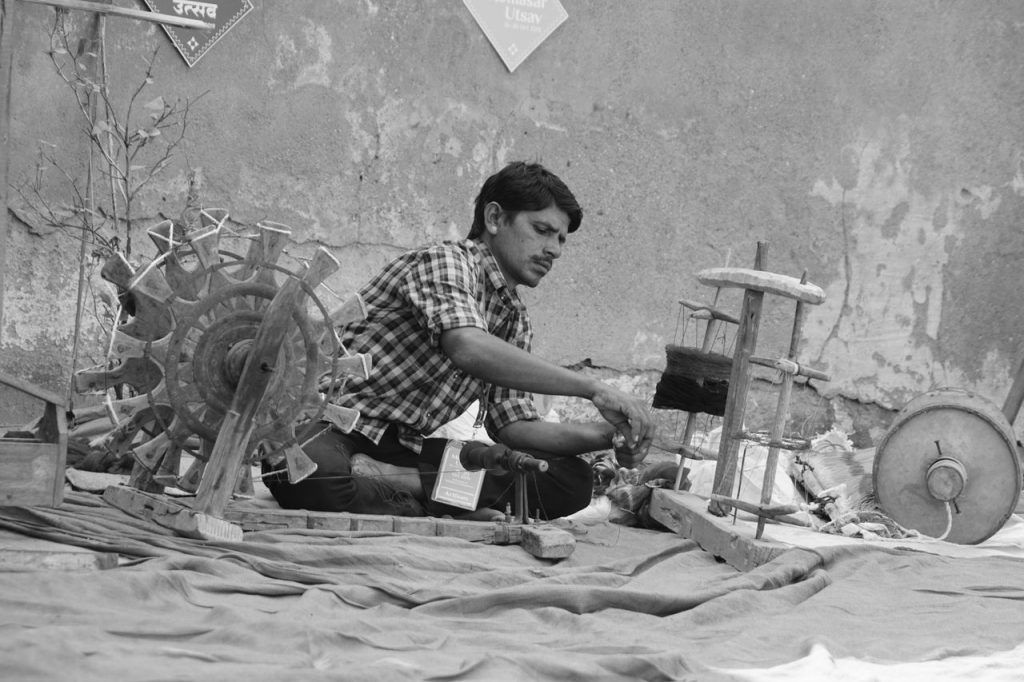
Khadi is not just another clothing label. It carries the weight of Gandhi, the Swadeshi movement, village employment and India’s hand-spinning and hand-weaving tradition.
But today, when a customer walks into a Khadi India outlet, how much of that history is actually in the garment?
And perhaps the more uncomfortable question is this:
Does every product carrying the word “Khadi” mean the same thing?
The answer is no.
First, what exactly is Khadi India?
Khadi India is the retail identity used by the Khadi and Village Industries Commission (KVIC) under the Ministry of MSME. KVIC is a statutory government body responsible for promoting Khadi and village industries.
The legal definition of Khadi is quite specific. Under the Khadi Mark Regulations, Khadi must be produced through hand spinning and hand weaving using natural fibres, principally cotton, wool or silk. A textile cannot legally be traded as Khadi without the required Khadi Mark.
This distinction matters enormously:
All Khadi is handwoven, but not all handloom is Khadi.
But Khadi India also sells synthetic-blended fabric
Here comes the confusing part.
The official Khadi India website itself currently lists products under the Polyvastra category. For example, one Khadi India suiting fabric is explicitly described as 67% cotton and 33% polyester, while another Poly Wool fabric contains 70% wool and 30% polyester.
A Khadi India Poly Vastra Bandi is also described as a handspun and handwoven combination of cotton and polyester.
So the issue is not whether synthetic-blended products exist in the KVIC ecosystem.
They do.
But there is an important technical distinction: Polyvastra is not the same thing as Khadi under the Khadi Mark system. KVIC’s own quality-assurance guidelines state that Khadi Mark signifies hand-spun, hand-woven natural-fibre Khadi and that Khadi Mark tags do not apply to Polyvastra.
In other words, consumers need to stop treating the words Khadi, Khadi India and Polyvastra as automatically meaning the same fabric.
Why did synthetic fibre enter the Khadi ecosystem?
This is not a recent development.
A BIS standard from 1993 specifically covered polyester-cotton blended Khadi (Polyvastra) suitings, noting that polyester blends were increasingly being used by organised buyers for uniforms.
The rationale was largely practical: better durability, easier maintenance, crease resistance and suitability for institutional requirements and modern clothing.
KVIC has therefore operated separate Khadi and Polyvastra categories for decades. Government programmes have also supported production and sales of Polyvastra alongside Khadi.
That history is important because synthetic blending in this ecosystem is not a secret conspiracy.
The real problem is something else:
Do consumers understand what they are buying?
A customer buying something because they associate Khadi with Gandhi, natural fibres, rural artisans and an environmentally conscious lifestyle may not realise that the particular fabric in front of them could contain a significant proportion of polyester.
A 67% cotton / 33% polyester fabric is very different from 100% cotton Khadi.
The label may disclose the composition — but the average consumer does not necessarily know the difference between Khadi, Polyvastra, handloom, handspun, handwoven and Khadi India.
That is where transparency becomes more important than branding.
And what about Khadi India franchisees?
The franchise model is surprisingly accessible.
KVIC’s published franchise application permits individuals, proprietorships, partnerships, private or public companies, NGOs, Self Help Groups and other legal entities to apply. The applicant must generally be financially sound, possess a PAN, provide three years of ITRs and have a showroom of at least 300 sq. ft., preferably air-conditioned and in a prime location.
The published terms also include:
- ₹5,900 non-refundable application fee.
- ₹50,000 refundable security deposit.
- ₹11,800 registration fee after approval.
- ₹50,000 fee for Khadi Mark usage.
- Five-year initial franchise period, subject to KVIC’s discretion for extension.
- No prescribed minimum annual sales target.
- Exclusive KVI-product retailing at the franchise outlet.
- Mandatory use of KVIC’s billing software.
- KVIC retains the right to conduct random quality checks. (www.Franchisehurt.com)
There is also a royalty structure based on annual sales: 3% up to ₹12 lakh, 2.5% from ₹12–30 lakh and 2% above ₹30 lakh, according to the published franchise document.
When a franchise buys directly from KVIC departmental sales outlets, the published terms mention a 35% trade discount on Khadi products and 25% on Village Industries products. But procurement from other approved Khadi institutions is also permitted, and the commercial terms are then between the supplier and franchisee.
So, is it profitable?
Potentially.
But there is no magical government-guaranteed profit.
Rent, salaries, electricity, interiors, inventory, working capital, GST compliance, local marketing and unsold stock can eat into the margin very quickly.
The brand gives credibility. It does not eliminate business risk.
Who checks whether the product is genuinely Khadi?
This is another area where consumers should understand the system.
Under the Khadi Mark framework, the Textiles Committee under the Ministry of Textiles has been used as an accredited agency for onsite verification and testing of Khadi and Khadi products. KVIC’s system is designed to verify hand-spinning, hand-weaving and natural-fibre requirements.
For franchise outlets, KVIC also reserves the right to conduct random checks to ensure the quality and sale of KVI products.
But this does not mean that every garment sold by every seller is individually laboratory-tested at the retail counter.
The system relies heavily on certification, approved sourcing and compliance.
That distinction should be clearly understood by consumers.
How many Khadi India franchises are there in each state?
Here we need to be honest rather than manufacture a beautiful-looking table.
KVIC’s current reporting format specifically asks state/divisional offices to report the number of franchisee sales outlets, alongside exclusive sales outlets and departmental units.
An older MSME annual report recorded just eight franchisees at that stage — Delhi (2), Pune (2), Kolkata (1), Aligarh (1), Navi Mumbai (1) and Kerala (1). That is historical information, not today’s count.
Therefore, claiming a current state-wise number without an official KVIC dataset would be misleading.
And that itself raises an interesting transparency question:
If franchise expansion is being promoted as a national business opportunity, shouldn’t the public be able to see an updated state-wise outlet map?
The Gandhi Jayanti sales record — but let’s get the date right
There is another common confusion.
The major Khadi sales records frequently highlighted by the government are associated with Gandhi Jayanti on October 2, not National Handloom Day on August 7.
On October 2, 2024, the Khadi Bhawan at Connaught Place, Delhi recorded an extraordinary ₹2.01 crore in sales in a single day — the highest single-day sales reported for a Khadi store in the country at that time. The figure included ₹67.32 lakh of cotton Khadi, ₹44.75 lakh silk Khadi, ₹7.61 lakh woollen Khadi, ₹1.87 lakh Poly Khadi, ₹65.09 lakh readymade Khadi and other products.
The progression is striking:
2021 — ₹1.01 crore
2022 — ₹1.34 crore
2023 — ₹1.52 crore
2024 — ₹2.01 crore
These figures are for the Connaught Place outlet, not total Khadi India sales across India.
National Handloom Day, meanwhile, is observed on August 7 and is specifically focused on India’s handloom sector.
That distinction matters because Khadi and the broader handloom sector are not interchangeable.
The uncomfortable question
If Gandhi’s Khadi represented self-reliance, village employment, simplicity and an alternative to industrialised textiles, where does a polyester blend fit into that philosophy?
There can be a practical answer: durability, affordability, crease resistance and institutional requirements.
But there is also an ethical question.
Polyester is fossil-fuel based. Synthetic textiles shed persistent microfibres during their life cycle, and unlike natural fibres, they do not simply return to nature at the end of their useful life.
So when we say “Khadi is sustainable”, we must ask:
Which Khadi?
100% handspun, handwoven cotton?
Silk Khadi?
Wool Khadi?
Or a handwoven cotton-polyester blend?
They are not environmentally equivalent.
And calling all of them simply “Khadi” in the consumer’s mind creates exactly the kind of ambiguity that responsible textile marketing should eliminate.
The franchise opportunity is real. So is the responsibility.
For an entrepreneur, a Khadi India franchise can offer an established government-backed identity, access to recognised KVI products, an existing customer base and a business model with relatively modest formal franchise fees.
For the consumer, however, the franchise signboard should never replace the question:
“What exactly is this fabric made of?”
And for the Khadi movement itself, perhaps the next revolution should not merely be about selling more.
It should be about telling consumers more.
Tell them whether it is handspun.
Tell them whether it is handwoven.
Tell them the exact fibre composition.
Tell them whether it is Khadi or Polyvastra.
Tell them who produced it.
Tell them where it was woven.
Because “Made in India” is not the end of the story.
And “Khadi” should never be the beginning of a customer’s assumptions.
The future of Indian textiles cannot be built merely by putting a government logo on a garment.
It must be built by restoring something far more valuable:
trust between the person who makes the cloth and the person who wears it.
Save Handloom Foundation’s position
We are not arguing that every synthetic blend is fraudulent, nor that Polyvastra should simply disappear.
We are asking for something much simpler:
Clear labelling. Clear fibre composition. Clear distinction between Khadi and Polyvastra. Clear provenance. And an informed consumer.
Because if we genuinely want to honour Gandhi, we should not ask people merely to buy Khadi.
We should first teach them what they are actually buying.