A Save Handloom Foundation Guide to 28 Clothing Materials — From Natural Fibres to Plastic
We wear fabric every day. Yet most of us rarely stop to ask the simplest question:
What exactly is this garment made from?
A shirt may be advertised as “eco-friendly.” A dress may be called “plant-based.” A sweater may be labelled “woollen.” A bag may proudly say “vegan leather.”
But marketing language can hide a very different reality.
The environmental impact of clothing depends on far more than whether a fibre comes from a plant or an animal. Water consumption, farming practices, chemicals, energy, durability, fibre shedding, recyclability and what happens to the garment after its useful life all matter.
And there is another important distinction that often gets ignored:
Natural fibre does not automatically mean sustainable. Synthetic fibre does not automatically mean useless. And “handmade” does not automatically mean handloom.
At Save Handloom Foundation, we believe consumers deserve to understand the material before they buy the garment.
The following guide examines 28 commonly encountered clothing materials, looking at what they are, where their major environmental concerns lie, and what consumers should know before buying them. The underlying material comparisons and classifications are drawn from the supplied research, while the explanations below have been independently written for consumer education.
1. Hemp — One of the Most Promising Plant Fibres
Hemp is one of the strongest candidates for low-impact clothing.
The plant generally requires considerably less water than conventional cotton and can grow with relatively little pesticide input. It also produces substantial fibre yields and can contribute organic matter back to the soil.
The fibre becomes softer with use and washing, while remaining durable.
So why don’t we see hemp clothing everywhere?
Availability and regulation.
Hemp cultivation and supply remain considerably more restricted than conventional textile crops in India, making genuine hemp fabric relatively difficult to source.
The lesson:
A highly sustainable fibre is of limited use if consumers cannot access it affordably and reliably.
2. Linen — The Fibre That Loves the Rain
Linen comes from the flax plant.
Unlike cotton, flax can be grown largely with rainfall rather than extensive irrigation. The plant can be utilised extensively, reducing waste during production.
Linen is also famous for durability. A good linen garment can remain useful for many years.
Its most obvious characteristic — wrinkles — is sometimes treated as a defect by the fashion industry.
Perhaps we should stop calling natural signs of a material a defect.
The lesson:
If you want a durable fabric for hot weather, linen deserves far more attention than it receives.
3. Khadi — Where Fibre Meets Human Hands
Khadi is particularly important to India because its story is not simply about fibre.
It is about spinning, weaving, employment, rural livelihoods and human skill.
Khadi generally uses cotton, but its production through hand-spinning and hand-weaving can significantly reduce dependence on large-scale mill processing and industrial energy.
It also has a practical advantage in India’s climate: breathable handwoven cotton can be exceptionally comfortable in hot weather.
But remember:
Not every fabric called “khadi” is automatically genuine hand-spun, hand-woven khadi.
Consumers should look for appropriate certification and traceability.
The lesson:
When you buy genuine khadi, you are not merely buying cloth. You are supporting a production system built around human labour and traditional skills.
4. Ramie — Strong, Natural and Still Niche
Ramie, sometimes called China grass, is a plant fibre known for strength and durability.
It shares some characteristics with linen and also has natural resistance to bacterial growth.
The problem lies further down the production chain.
Turning the raw plant material into usable fibre requires significant processing, including degumming. That additional processing and labour have prevented ramie from becoming a mainstream clothing fibre.
In India, it is more likely to appear within specialised textiles or blends than as a widely available pure fabric.
The lesson:
A plant fibre can still require substantial processing. “Plant-based” is only the beginning of the story.
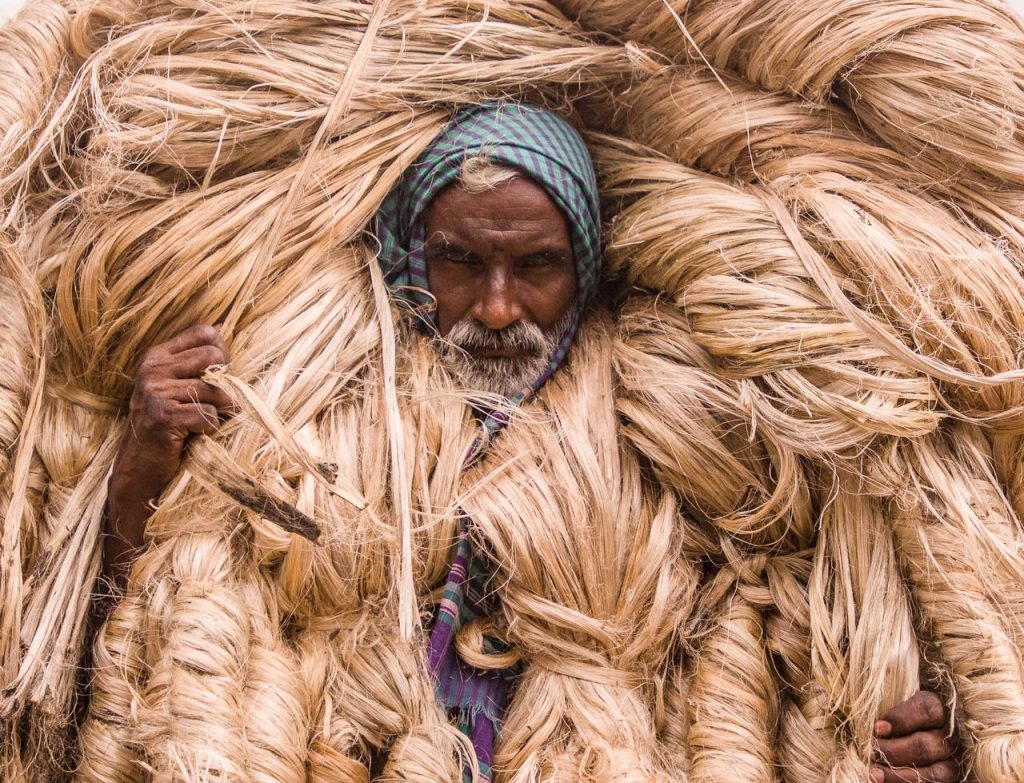
5. Jute — India’s Golden Fibre
Jute is one of India’s great natural resources.
It grows efficiently, generally requires relatively little irrigation, and is biodegradable. India is also a major global producer.
Its traditional coarse texture has historically limited its use in everyday clothing.
But that is changing.
Jute is increasingly appearing in bags, jackets, home textiles and innovative apparel blends.
The lesson:
Sometimes sustainability does not require inventing a new material. It requires finding better uses for materials we already grow.
6. Recycled Cotton — Clothing Without Starting With a New Crop
Recycled cotton offers an important advantage: the fibre has already been produced once.
Instead of growing another cotton crop, textile waste can be processed and converted into new yarn or fabric.
The challenge is fibre length.
Recycling can shorten cotton fibres, making them weaker. Consequently, recycled cotton may need to be combined with virgin fibres to produce stronger fabric.
This is still valuable, because avoiding new agricultural production can reduce pressure on land and water.
The lesson:
Recycling is useful — but designing garments for recyclability in the first place is even better.
7. Recycled Wool — An Old Indian Practice Worth Respecting
Recycled wool, often associated with shoddy yarn, is not a futuristic invention.
India has been recycling old woollen garments for decades.
Existing wool textiles are shredded and spun again, avoiding the need for new grazing, new raw fleece production and associated processing.
This is a powerful example of something we should remember:
Circular fashion does not necessarily require high-tech factories. Traditional systems of reuse can already do much of the work.
The lesson:
Before celebrating a new “circular” fashion technology, look at the traditional circular practices that communities have already been using.
8. Lyocell / TENCEL — Better Regenerated Fibre, But Still Regenerated
Lyocell is made from wood pulp.
It is often regarded as a better alternative to conventional viscose because its production can recover and reuse most of the solvent involved in processing.
The fabric is soft, drapes well and can biodegrade under appropriate conditions.
But calling it simply a “natural fibre” is misleading.
The fibre is regenerated through industrial processing. Its environmental performance also depends on the source and management of the wood used to produce the pulp.
The lesson:
A fibre can be significantly better than another without being completely natural.
9. Organic Cotton — Better Farming, But Not Water-Free
Organic cotton eliminates synthetic pesticides and fertilisers from certified organic production systems.
That can benefit soil health, ecosystems and farming communities.
But there is a misconception worth correcting:
Organic does not mean zero environmental impact.
Cotton remains a thirsty crop, and yields can differ depending on agricultural conditions.
Organic cotton therefore represents an improvement in farming practices, but it should not be treated as a magic environmental solution.
The lesson:
Always ask: Organic by what standard?
A genuine certification matters more than a green label.
10. Alpaca — A Relatively Low-Impact Animal Fibre With Limited Indian Availability
Alpaca fibre comes from South American camelids.
Compared with some intensive livestock systems, alpacas can have a relatively low-impact grazing profile.
The bigger problem for Indian consumers is availability.
The material is not widely produced domestically and therefore has a long supply chain before reaching the Indian consumer.
The lesson:
A material’s environmental profile must include the entire supply chain — not simply what happens on the farm.
11. Wool — Durable, Warm and Complicated
Wool has an enormous advantage:
It can last for years.
A good wool garment may be worn repeatedly, washed relatively infrequently and remain useful for decades.
But wool is an animal fibre, and livestock production has environmental costs, including methane emissions and land use.
The type of farming matters enormously.
Well-managed extensive or regenerative grazing can produce a very different outcome from intensive systems.
The lesson:
Never judge a fibre using one metric alone. Durability can dramatically change the impact per wear.
12. Eri Silk — Silk With a Different Philosophy
Eri silk is often associated with Ahimsa or peace silk because the moth is allowed to leave the cocoon before the silk is collected.
It is strongly associated with Assam and the North East.
Compared with conventional mulberry silk, eri has a distinctive texture and warmth and represents an important regional textile tradition.
But consumers should still distinguish between genuine eri silk and products using misleading labels.
The lesson:
Sustainability also includes culture, traditional knowledge and regional livelihoods.
13. Pashmina — Luxury That Needs Authenticity
True pashmina is associated with the fine fibre of Changthangi goats from Ladakh.
The production volumes are limited, and genuine pashmina is labour-intensive.
There is also an ecological concern: fragile high-altitude grasslands can suffer from grazing pressure.
And then there is the giant elephant in the room:
Counterfeiting.
A product labelled “pashmina” is not automatically genuine pashmina.
Certification, geographical identification and traceability matter.
The lesson:
When the material is rare and expensive, authenticity becomes part of sustainability.
14. Mulberry Silk — Beautiful, Biodegradable and Resource Intensive
Mulberry silk is one of the world’s most luxurious natural fibres.
It is biodegradable and can have relatively low land requirements.
However, silk production involves substantial water and energy requirements, and conventional silk production involves killing the silkworm within the cocoon.
There is also a positive side that cannot be ignored:
A well-made silk garment, particularly a saree, can remain in a family for generations.
The lesson:
A garment worn for decades has a very different environmental story from one discarded after a handful of uses.
15. Modal — Soft, But Look Beyond the Name
Modal is a regenerated cellulose fibre commonly produced from beechwood pulp.
It is known for its softness and is widely used in innerwear, loungewear and other garments.
High-quality certified production can involve improved chemical recovery systems.
But the word “modal” alone does not tell consumers everything they need to know about the production process.
The lesson:
Brand and certification can matter as much as fibre name.
16. Conventional Cotton — Natural Does Not Mean Impact-Free
Cotton is biodegradable and comfortable.
It is also one of the most important fibres in Indian clothing.
But conventional cotton can require substantial water and pesticide inputs. The often-repeated “natural fibre” label can therefore create a misleading impression that cotton has no environmental cost.
It does.
Yet cotton still has a major advantage over many synthetic fibres:
It does not leave permanent plastic fibres behind.
The lesson:
The answer is not necessarily “stop wearing cotton.” It is buy better cotton, wear it longer and waste less of it.
17. Vegetable-Tanned Leather — Durable, But Not Impact-Free
Vegetable-tanned leather uses tannins derived from plant materials rather than conventional chromium-based tanning.
That can avoid some of the chemical concerns associated with chrome tanning.
But leather still carries the environmental footprint of cattle production.
Its strongest argument is longevity.
A well-made leather shoe or bag can last for many years, sometimes decades, instead of being replaced repeatedly.
The lesson:
Durability matters. But durability should never be used to pretend that a material has zero environmental cost.
18. Recycled Polyester — The Better Plastic, Not a Natural Fibre
Recycled polyester can reduce demand for virgin fossil-based feedstock and make use of existing plastic waste.
That is a meaningful advantage.
But recycled polyester remains polyester.
It can still shed microfibres during washing, and converting bottles into textiles does not necessarily create a closed-loop system in which the garment can easily become another garment.
The lesson:
“Recycled” does not mean “plastic-free.”
If you need performance clothing, recycled polyester may be a reasonable choice. But it should not be marketed as equivalent to a natural fibre.
19. Viscose / Rayon — The Plant Story That Can Hide the Chemical Story
Viscose starts with cellulose, commonly from wood pulp.
That sounds wonderfully natural.
But cellulose must be chemically dissolved and regenerated to create the final fibre.
Conventional viscose production has significant chemical and forest-related concerns, particularly where chemical recovery is poor or wood sourcing is irresponsible.
The lesson:
Knowing where a fibre begins is not enough. You must know how it becomes fabric.
20. Bamboo Fabric — Beware the Bamboo Marketing
This is one of the biggest consumer misunderstandings in sustainable fashion.
Bamboo is an impressive plant.
But bamboo fabric is not necessarily bamboo fibre in the way consumers imagine.
Much of what is sold as bamboo textile is actually bamboo-derived viscose: bamboo is processed into cellulose pulp and then chemically regenerated into fibre.
The bamboo plant may be sustainable.
That does not automatically make the finished textile sustainable.
The lesson:
Never buy a fabric simply because the label says “bamboo.”
Ask what the fibre composition and production process actually are.
21. Cashmere — Luxury With a Grassland Problem
Cashmere comes from specialised goats, including Changra and Mongolian goats.
Each animal produces relatively small quantities of fine fibre, which makes cashmere expensive.
As demand increases, herd sizes can increase as well.
Goats can place significant pressure on fragile grasslands because of their grazing behaviour.
This creates an uncomfortable contradiction:
A luxury fibre can be environmentally fragile precisely because it is so desirable.
The lesson:
Luxury does not automatically mean sustainability.
22. Chrome-Tanned Leather — The Industrial Default
Chrome tanning is widely used because it is efficient and commercially practical.
But chromium-containing tanning processes create serious environmental management challenges where wastewater treatment is inadequate.
Leather also carries the broader footprint associated with cattle production.
This does not mean every leather product is automatically irresponsible.
It means consumers should understand that “real leather” is not synonymous with “environmentally friendly.”
The lesson:
Natural origin and environmental responsibility are not the same thing.
23. Polyester — The Fabric That Changed the Wardrobe
Polyester is cheap, strong, versatile and easy to manufacture.
That is precisely why it has become so dominant.
But polyester is fundamentally a plastic-based fibre derived from fossil resources. It can shed microscopic plastic fibres during washing, and it does not readily biodegrade after disposal.
Its affordability has helped millions of people access clothing.
So the conversation should not become a simplistic attack on consumers who buy polyester.
The bigger problem is a system built around cheap clothes, enormous volumes and short lifespans.
The lesson:
The environmental disaster is not just polyester.
It is polyester + overproduction + overconsumption + disposal.
24. Nylon / Polyamide — Strong, Useful and Environmentally Expensive
Nylon is extremely durable and useful in applications requiring strength, stretch or abrasion resistance.
It is used in sportswear, swimwear, linings, umbrellas and many technical products.
However, its production has a significant climate impact, including emissions associated with nitrous oxide in some manufacturing pathways.
The lesson:
Use high-performance synthetics where their performance is genuinely necessary — not simply because they are cheap.
25. Poly-Cotton Blends — The Recycling Nightmare
Poly-cotton sounds like the best of both worlds.
Cotton provides comfort.
Polyester provides strength and affordability.
But there is a major problem at the end of the garment’s life:
The fibres are difficult to separate.
You have effectively combined a natural fibre with a plastic fibre into one textile that is much harder to recycle.
This is one reason single-fibre garments can be preferable whenever performance requirements allow.
The lesson:
A blend may improve a garment’s performance while making its end-of-life management much worse.
26. Acrylic — The Fake-Wool Problem
Acrylic is often used to imitate wool.
It is inexpensive, warm and lightweight.
But it is a synthetic plastic fibre and can shed substantial quantities of microfibres during washing.
It also tends to pill, which can make garments look worn sooner and encourage replacement.
The lesson:
If a garment says “woollen,” check whether the composition actually says wool or acrylic.
They are not the same thing.
27. Elastane / Spandex — Useful When Necessary, Problematic When Unnecessary
Elastane provides stretch.
In some garments, that stretch is genuinely necessary.
Sportswear, socks and certain fitted garments can be difficult to produce without it.
The problem begins when elastane is added to garments that do not actually need stretch.
Even a small percentage can complicate textile recycling because the fibres are mixed together.
The lesson:
The question is not “Is elastane evil?”
The better question is:
Does this garment actually need it?
28. PVC “Vegan Leather” — Vegan Does Not Mean Green
Perhaps one of the most misleading labels in modern fashion is “vegan leather.”
Vegan tells you that the material is not animal-derived.
It does not tell you that it is biodegradable, non-toxic or environmentally friendly.
PVC “vegan leather” is plastic.
Its production and disposal raise concerns around plasticisers and hazardous emissions, while low-cost PVC products may have very short useful lifespans.
There are other plant-based and innovative alternatives emerging, but consumers should never assume:
Vegan = sustainable.
The lesson:
Animal-free and environmentally friendly are two different claims.
The Biggest Lesson Is Not Actually About Fabric
After looking at all these materials, it is tempting to ask:
“So which fabric is the winner?”
But that is the wrong question.
The more important question is:
“How long will I actually use what I buy?”
A relatively low-impact fibre becomes wasteful if a garment is worn twice and discarded.
A material with environmental disadvantages can have a much better outcome if an existing garment is repaired and worn for ten years rather than replaced immediately.
The supplied research emphasises this lifecycle principle: environmental impact should be considered across water, land, chemistry, carbon, lifespan, fibre shedding and end-of-life — not through fibre type alone.
The Six Questions Every Consumer Should Ask
Before buying your next garment, ask:
1. What is the fibre composition?
Don’t stop at the front-of-package marketing.
Turn the garment around.
Read the composition label.
2. Is it a single fibre?
Whenever practical, single-fibre clothing is easier to manage at the end of its life.
3. Does it contain polyester, acrylic, nylon or elastane?
If yes, ask yourself whether the synthetic component is actually necessary.
4. How long will I wear it?
If the honest answer is “probably a few times,” don’t buy it.
5. Can I repair it?
A loose seam does not mean a dead garment.
6. What happens after I stop wearing it?
Can it be passed to someone else?
Can it be repurposed?
Can it be recycled?
Don’t Throw Away the Polyester You Already Own
This point is extremely important.
Sustainable fashion can become ridiculous when people throw away perfectly usable synthetic clothing simply to replace it with supposedly “better” fabric.
That creates new production impact.
If you already own a polyester shirt and it is still perfectly usable:
Wear it. Maintain it. Repair it. Use it until the end of its useful life.
Your next purchase can be better.
You don’t need to throw today’s garment into the bin to prove tomorrow’s values.
And This Is Where India Has Something the Fashion Industry Forgot
India still has something that many highly industrialised societies have lost:
repair culture.
Tailors repair clothes.
Cobblers repair footwear.
Families pass clothing from one person to another.
Old cotton garments become cleaning cloths, quilts and household material.
Traditional textile communities have reused, repaired and repurposed materials long before “circular fashion” became a corporate presentation.
The research also highlights air drying, repair and passing clothes through families and communities as existing strengths in India’s clothing culture.
The question is:
Will we preserve these habits, or replace them with disposable fashion?
Handloom Is About More Than the Word “Natural”
This is particularly important for the handloom movement.
A handloom fabric is not automatically environmentally perfect merely because a human being operated the loom.
But genuine handloom can bring together several powerful principles:
- Natural fibres
- Human skill
- Lower dependence on industrial machinery
- Longer product lifespans
- Regional production
- Traditional knowledge
- Rural employment
- Cultural preservation
- Repairability
- Smaller-scale production
And when a handloom garment is made from a single natural fibre and worn for many years, its story becomes considerably stronger.
But consumers must also be vigilant.
Powerloom fabric is not transformed into handloom simply because somebody adds a traditional-looking design, zari, border or finishing process.
Handloom authenticity matters.
The Real Enemy Is Not One Fibre
It is easy to declare:
“Polyester is bad.”
“Cotton is good.”
“Bamboo is sustainable.”
“Vegan leather is ethical.”
But the real world is more complicated.
The bigger enemy is a fashion culture where:
cheap → trendy → few wears → discard → replace
has become normal.
The better model is:
choose carefully → buy less → wear longer → repair → pass on → repurpose → recycle
That is the real transition we need.
A Better Wardrobe for India
For everyday clothing, natural cotton, organic cotton, khadi, handloom cotton and linen can be strong choices depending on the garment and production method.
For winter, genuine wool or recycled wool can make more sense than acrylic.
For sarees, genuine handloom cotton, eri silk and properly identified regional weaves deserve attention.
For performance clothing, recycled synthetics can sometimes be the practical choice.
For rainwear, technical synthetic materials may genuinely serve a purpose.
The goal is not to create a world where every garment is made from one magical fibre.
The goal is to stop using materials unnecessarily and start matching the material to the purpose.
The Save Handloom Foundation Test
At Save Handloom Foundation, we believe every garment should ultimately pass four tests:
WHAT IS IT MADE OF?
Know the actual fibre.
WHO MADE IT?
Know the maker, weaver or producer wherever possible.
HOW LONG WILL IT LAST?
Durability matters more than fashion cycles.
WHAT HAPPENS WHEN I’M DONE WITH IT?
Repair, reuse, pass it on, repurpose — and recycle where genuinely possible.
Because sustainability isn’t printed on a hangtag.
It is demonstrated by the entire life of the garment.
The Bottom Line
There is no perfect fibre.
There are better choices, worse choices, necessary choices and unnecessary choices.
Hemp, linen, khadi, ramie, jute, recycled cotton and recycled wool demonstrate the potential of low-impact or circular materials.
Organic cotton and responsibly produced regenerated fibres can offer improvements under the right conditions.
Wool, silk, pashmina, alpaca and leather require us to consider animal welfare, land, water, processing and — crucially — longevity.
Polyester, nylon, acrylic, elastane, PVC and synthetic blends remind us that affordability and performance often come with environmental trade-offs.
And materials such as viscose, modal and bamboo demonstrate why the label alone is never enough.
The next time you stand in front of a clothing rack, don’t ask only:
“Does this look good?”
Ask:
“What is this made of?”
“Who made it?”
“How long will I wear it?”
“What will happen when I’m finished with it?”
Because every purchase is a vote.
And if millions of consumers start reading the fibre label before reading the marketing label, the fashion industry will eventually have no choice but to listen.
Wear better. Buy less. Repair more. Respect the fibre. Respect the maker.
Save Handloom Foundation
For a future where clothing is valued not because it is new, but because it is well made, responsibly produced and worth keeping.