
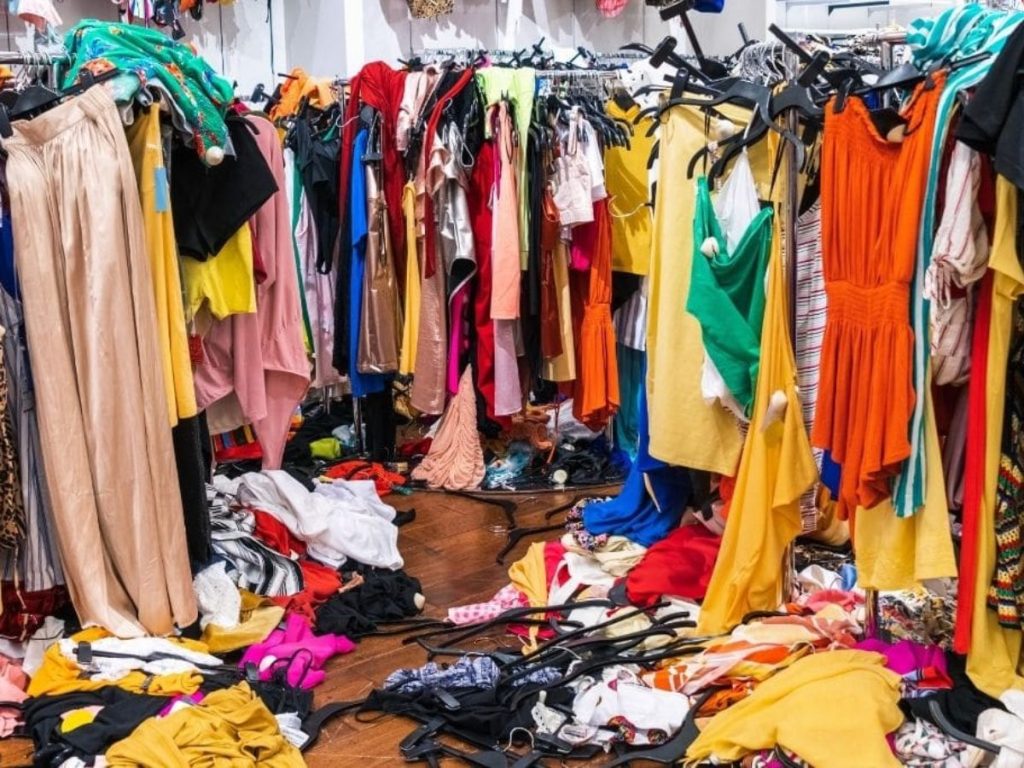
Fast fashion has become the world’s most democratic luxury.
A ₹299 T-shirt.
A ₹799 dress worn once for Instagram.
A new trend every two weeks.
Cheap. Fast. Disposable.
But clothes, unlike selfies, don’t vanish after use.
They travel.
And increasingly, they end up in India.
Not in closets.
Not in charity.
But in mountains of waste.
India is quietly becoming the world’s textile dumping ground.
The Dirty Secret Behind “Donations” and “Recycling”
Western countries publicly preach sustainability.
Privately, they export their guilt.
Every year, millions of tonnes of used clothing are shipped from the US, UK, Europe, and Australia to countries in Africa and South Asia — especially India.
Official labels say:
- “Second-hand clothing”
- “For reuse”
- “For recycling”
Reality:
- 30–40% is unusable on arrival
- Torn, stained, synthetic, low-quality
- Impossible to resell
- Impossible to recycle properly
So where does it go?
To India’s landfills.
India’s Major Landfills: Where Clothes Go to Die
These are not abstract places.
They are real, living mountains.
1. Ghazipur Landfill – Delhi
- Height: Over 65 meters (taller than a 20-storey building)
- Age: Operating since 1984
- Receives: Municipal waste + textile waste
- Known for fires, methane leaks, collapses
Synthetic clothes here will outlive your grandchildren.
2. Bhalswa Landfill – Delhi
- Surrounded by poor communities
- Frequent landfill fires
- Leachate flows into groundwater
- Textile waste mixed with plastic and chemicals
People live next to a slow poison factory.
3. Okhla Landfill – Delhi (closed, but still toxic)
- Continues to emit methane
- Soil contamination persists
- Buried textile waste still decomposing chemically
Closed landfills never really close.
4. Deonar Landfill – Mumbai
- One of Asia’s largest and oldest
- Over 132 hectares
- Regular fires, toxic smoke
- Textile waste from Mumbai’s fashion and recycling clusters
Residents breathe fashion waste daily.
5. Perungudi & Kodungaiyur – Chennai
- Key dumping grounds for urban and industrial waste
- Major receivers of textile and plastic waste
- Adjacent to wetlands and water bodies
At the Perungudi dumpyard, 96 acres of a 226-acre landfill filled over 50 years has been scientifically processed. Around 1.7 million cubic metres of legacy waste is now reborn as furniture, slabs, tiles, and bottles using Indian biomining technology. 🇮🇳✨
What Happens to Fast Fashion Waste in India?
Here is the uncomfortable chain:
- Western consumers discard clothes after 3–5 wears
- Shipped as “donations” or “recyclables”
- Land in sorting hubs in Panipat, Kandla, Mumbai, Tiruppur
- Best pieces resold in local markets
- Low-grade synthetics go to:
- Shredding units
- Low-quality insulation
- Wiping cloths
- Or directly to landfills
And the worst part?
Most fast fashion is made of polyester.
Plastic.
Not fabric.
The Health Cost No One Talks About
In recycling clusters like:
- Panipat (Haryana)
- Tiruppur (Tamil Nadu)
- Mumbai slums near Deonar
- Delhi NCR informal sorting hubs
Workers — often migrants and women — face:
- Continuous inhalation of microfibers
- Exposure to toxic dyes and finishes
- Skin diseases
- Respiratory disorders
- Hormonal disruption from chemicals
No gloves.
No masks.
No insurance.
Sustainability for the West.
Suffering for the Global South.
Recycling Is Not the Hero You Think It Is
Textile recycling sounds noble.
Reality:
- Only 1% of clothes are recycled back into clothes
- Most are downcycled into low-value products
- Mixed fabrics (cotton + polyester) are almost non-recyclable
- Recycling itself releases microplastics into water and air
Recycling is not a solution.
It is a damage control strategy.
The real problem is overproduction.
Fast Fashion’s Mathematical Crime
Let’s talk numbers:
- Global clothing production has doubled since 2000
- Average garment use has dropped by 36%
- Over 100 billion garments produced annually
- India imports hundreds of thousands of tonnes of used clothing each year
This is not fashion.
This is planned waste.
The Moral Question We Avoid
Every cheap dress has a journey.
- A worker in Bangladesh
- A consumer in London
- A sorting unit in Delhi
- A landfill in Ghazipur
When you throw away a ₹500 T-shirt, you are not throwing it “away”.
You are throwing it at someone else’s lungs, water, and land.
The Irony: India, the Land of Sustainable Textiles
India gave the world:
- Handloom
- Natural dyes
- Cotton, silk, wool, linen
- Repair culture
- Long-life garments
And now India is paying for the world’s synthetic addiction.
The country that taught durability is now managing disposability.
What Needs to Change — Immediately
This is not a consumer-only problem.
This is a system failure.
1. Ban Low-Quality Textile Imports
India must strictly regulate second-hand clothing imports.
Dumping should not be disguised as charity.
2. Make Brands Responsible
Extended Producer Responsibility (EPR) for fashion:
- Brands must take back waste
- Fund recycling
- Pay for environmental damage
3. Stop Greenwashing
“Conscious collection” means nothing if:
- 52 collections a year continue
- Overproduction remains untouched
4. Support Slow Fashion
- Handloom
- Repair
- Durable design
- Fewer clothes, better clothes
The Final Question
Fast fashion made clothing cheap.
But it made land, water, air, and human lives expensive.
Every landfill in India is a receipt.
A receipt for:
- Western overconsumption
- Corporate greed
- And global hypocrisy
The real price of fast fashion is not on the tag.
It is written on India’s landfills.
And the bill is still rising.