
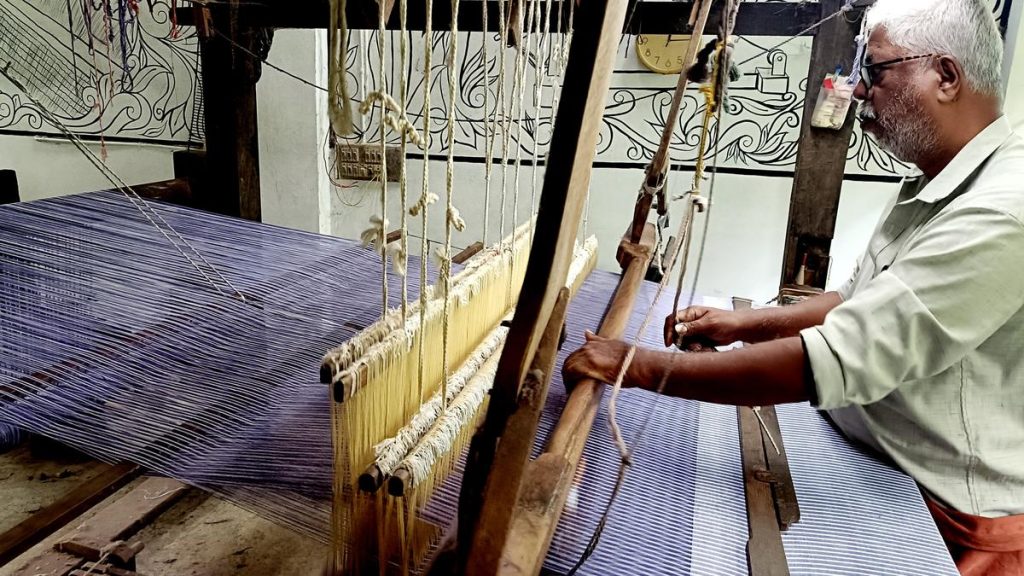
Kannur.
The land of tharikals and thiras.
A place where the rhythmic clatter of looms once echoed like a heartbeat.
A land whose fame travelled far — not just across districts, but over seven seas, right up to Buckingham Palace and the White House.
Yes, the world once waited for fabrics woven in Kannur. Today, Kannur waits for its weavers.
This is the uncomfortable truth nobody likes to say out loud — one of India’s proudest handloom legacies is dying, thread by thread, because we allowed it to.
A Heritage That Began Centuries Ago
History records that by the 16th–17th century, Kannur had already established itself as a handloom stronghold.
The Kolathiri royal family brought skilled Shaliya families from Tamil Nadu and settled them in Kadalaayi, which soon turned into Kannur’s first weaving street.
Then came the Basel Mission workers. And with them, the game-changer:
The Frame Loom.
Imported from Germany.
Faster. More efficient.
The engine that powered Kannur’s explosive growth in handloom production.
By the late 1800s, Kannur earned a new title:
“The Manchester of Kerala.”
That wasn’t a poetic exaggeration. Exports boomed. Europe bought our table linens, bed covers, curtains, sofa fabrics, and kitchen textiles in massive volumes.
And by the early 2000s, the world couldn’t get enough of Kannur’s home furnishings.
When Kannur Ruled the Global Home Furnishing Market
Around 2000–2005, Kannur handlooms were exporting directly to major retailers, global home décor brands, and distributors across:
- United States
- United Kingdom
- Germany
- Italy
- France
- Spain
- Netherlands
- Japan
- Australia
The products?
A full universe of exquisite home textiles:
- Tablecloths
- Bedspreads
- Kitchen towels
- Curtains
- Cushions
- Sofa fabrics
- Beach towels
- Cotton throws
- Terry products
- Decorative linens
So refined were these, that special editions were produced for royal households and presidential estates.
Exports from Kannur made their way to Buckingham Palace and the White House, representing Indian craftsmanship with unmatched pride.
And Then… The Decline. The Slow Death Nobody Stopped.
Once upon a time, Kannur had over 5 lakh weavers.
Today?
Barely 5,000 remain.
No, that number is not a typo.
It is a tragedy.
What happened? Why did a global giant collapse?
Let’s go straight to the uncomfortable truths.
1. Zero Yarn Availability in Kerala — A Disaster Nobody Addressed
Earlier, Kannur’s looms were supported by a strong intra-state yarn network.
Now, weavers don’t get:
- quality yarn
- timely supply
- fair pricing
Kerala mills have collapsed.
Weavers are forced to buy yarn from Tamil Nadu, Gujarat, Karnataka, often at inflated rates.
This directly kills margins — and hope.
A weaver cannot fight the market when even the yarn fights them.
2. Powerloom & Synthetic Fibre Invasion
Markets shifted to cheaper, faster textiles:
- polyester
- viscose
- nylon
- mixed blends
- powerloom-made “handloom-like” fakes
While the world became addicted to low price, Kannur’s craft could not compete with the speed and scale of powerlooms.
3. No New Weavers Are Entering — For One Simple Reason: Hunger
Why would a youngster choose handloom when:
- daily wage is too low
- payments are delayed
- job security is zero
- respect is minimal
- no health benefits
- no pension
- no social safety
The craft became a cage instead of a career.
Parents tell their children:
“Neythu venda… athinu bhaviyilla.”
(Don’t weave… it has no future.)
And that sentence killed more looms than any machine.
4. Export Collapse After 2005
The biggest blow came from:
- compliance demands
- rising raw material costs
- lack of design innovation
- absence of branding
- failure to adopt modern technology
- global buyers shifting to cheaper producers
- outdated cooperative structures
Foreign buyers moved to Vietnam, Bangladesh, Turkey, and China.
Kannur lost its global throne.
5. Cooperatives That Once Ruled Exports Are Barely Surviving
Some of the biggest export-focused cooperatives included:
1. Kannur Handloom Weavers Co-operative Society (KHCS)
Exported large volumes to the US, UK, France, Germany — especially table linen, bed linen, curtains, kitchen textiles.
2. Malabar Handloom Co-operative Societies
Known for their superior quality cotton home furnishing fabrics.
3. Cannanore Handloom Exporters Consortium
Played a major role in exporting value-added home décor.
4. Kadambur & Chirakkal Handloom Societies
Sent beautiful jacquard and dobby designs abroad.
Today, many of them are shadows of their former strength.
6. GI Recognition With No Real Benefit
Kannur received GI (Geographical Indication) status for home furnishings.
But what is the use of GI when:
- nobody enforces it
- fake products flood the market
- weavers get no premium
- exporters don’t leverage it
- buyers never see it being promoted
A GI without protection is just a sticker — not a safeguard.
Why Is Nobody Talking About This?
Because uncomfortable truths make people uncomfortable.
Because handloom doesn’t have glamour.
Because policy makers love fancy schemes more than ground reality.
Because synthetic fiber brands have louder marketing budgets than weavers have meals.
Where Do We Go From Here? Can Kannur Be Revived?
Yes.
But only if we stop “romanticizing” handloom and start rebuilding it.
And that is where Save Handloom Foundation enters with a mission larger than emotion:
1. Digital Product Passports (DPP) with Blockchain
Every Kannur handloom product can carry:
- weaver details
- raw material details
- process transparency
- authenticity proof
- QR/NFC-based traceability
This kills counterfeits and brings global trust back.
2. Fair Trade Pricing & Transparent Margins
We ensure the weaver is not the last person paid.
3. Tech-Driven Revival
Blockchain
AR
AI
Digital supply chain
NFC chip–embedded authenticity cards
No more middlemen swallowing the value.
4. Youth Skill Revamp
Teaching new-age weaving, contemporary design, and financial literacy.
5. Policy Advocacy
We push for yarn availability, GI enforcement, subsidies, and better welfare systems.
Kannur handloom should not survive on charity —
it should thrive on innovation, dignity, and global demand.
The Harsh Truth We Must Accept
If we don’t act now, the next generation will only know Kannur handloom through museum labels and nostalgia-filled YouTube videos.
A land once called Kerala’s Manchester is now dangerously close to becoming Kerala’s forgotten chapter.
The Final Thought
Handloom is not dying because the craft is weak.
It is dying because the system made the craftsman weak.
But revival is possible —
not with pity,
not with slogans,
but with technology, fair wages, global branding, and uncompromising transparency.
Save Handloom Foundation believes Kannur can rise again — not as a memory, but as a movement.
And this time, the world will not just see Kannur’s fabrics.
They will see its truth, its tradition, and its technology — woven together, stronger than ever.